The Corridor Curriculum: Reinstating the Apprenticeship Layer That Hybrid Work Dissolved
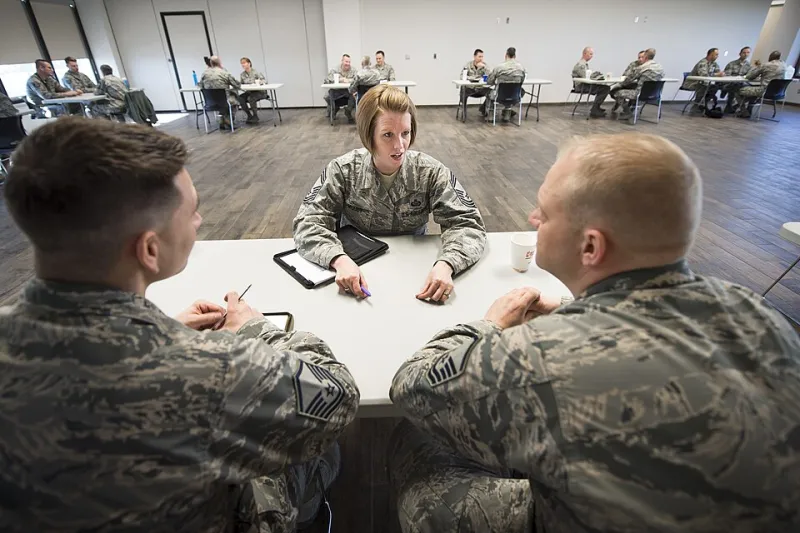
Photo: U.S. Air Force photo by Dennis Rogers, Public domain, via Wikimedia Commons
When most American employers rewrote their working models between 2021 and 2023, the variables under discussion were output, square footage, and attrition. Nobody put a metric on how a twenty-six-year-old analyst learns to recognize a bad deal structure, because nobody had ever measured it. It was not measured because it did not need to be designed. It was a byproduct of proximity, and proximity was free.
It is no longer free, and it is no longer automatic.
The Curriculum That Was Never on a Syllabus
The most consequential learning in a professional organization has always happened in the gaps between scheduled activity. A junior colleague sits within earshot of a client call that goes sideways and absorbs, without instruction, the moment the account executive stops negotiating. A manager pauses in a doorway for forty seconds to explain why the contract was structured that way and not the obvious way. A draft comes back with three edits and a sentence of reasoning, delivered while the thinking is still warm.
None of this appears in a training catalog. It is indexed to situations rather than topics, which is why it transfers so efficiently: the lesson arrives attached to the context in which it will be needed.
What Actually Broke
Four mechanisms degraded, and they degraded at different rates.
- Shadowing. Observing work in progress rather than reviewing its polished output. Remote scheduling tends to circulate finished artifacts, which are the least instructive version of any piece of work.
- Overheard reasoning. The casual explanation that reveals why a decision was made. This is the highest-yield and most fragile of the four.
- Immediate correction. Feedback delivered within minutes, while the junior person still holds the full context of what they were attempting.
- Peripheral awareness. Knowing what is in flight, who holds influence over it, and which norms apply — the ambient map that lets a new employee act without asking permission for every move.
Each of these depends on shared time and unplanned adjacency. Each of them survived, in attenuated form, through scheduled video calls. None of them survived intact.
Why a Course Cannot Fill the Hole
Organizations responded reasonably: more structured onboarding, more recorded content, more mentoring programs. These help at the margins and cannot substitute at the core.
Tacit knowledge is situational. A course can teach the framework for prioritizing a portfolio; it cannot teach the point at which an experienced operator abandons the framework. Recorded content has a second disadvantage: it is polished. The hesitation, the second-guessing, the visible recalculation — these are the pedagogy, and they are precisely what gets edited out of a well-produced module.
Meanwhile, learning-and-development capacity is finite and curriculum cycles lag the actual work by months. The pipeline that used to fill itself now requires deliberate plumbing.
Four Rituals That Restore the Layer
None of these requires a return-to-office mandate. All of them require that someone own the outcome.
The second chair. Junior staff attend consequential decision meetings as silent observers, followed by a five-minute debrief in which they articulate what they heard and the senior person corrects the reading. The value is entirely in the debrief; attendance alone produces nothing.
Decision notes. One paragraph per consequential decision, written by the person who made it, recording the options considered and the ones rejected. A searchable archive of these becomes a functional substitute for overhearing — imperfect, but far better than nothing. The discipline of writing them also improves the decisions.
Warm correction windows. A twenty-minute weekly review of work in progress, in which the junior person presents the draft and the senior person asks questions instead of issuing edits. Questions transfer judgment; edits transfer only the current version of the document.
Rotating domain ownership. A named weekly responder for each significant domain, assigned to junior staff with a senior backstop. Being the person who must answer forces articulation, and articulation exposes exactly which parts of the understanding are missing.
A fifth practice is worth considering for distributed teams: two anchor days per quarter designed around shared work rather than around meetings, so that adjacency exists at least occasionally by design.
Measuring What Was Never Measured
If the apprenticeship layer matters, it can be observed. Four proxies are enough to start.
Time to first independent decision, tracked by cohort rather than by individual. The number of junior staff who have presented to a client or led a formal review within their first year. The number of critical roles with at least one named, ready successor. And escalation quality — whether junior staff escalate the right problems at the right moment, which is the clearest available signal that judgment is transferring rather than accumulating at the top.
The Design Choice
Hybrid work is not the cause of the pipeline problem. Unexamined hybrid work is. The apprenticeship layer was always an operating cost of co-location, paid silently and never invoiced. It is now a line item that has to be designed, staffed, and reviewed — or it will continue to shrink while every dashboard reports that things are fine.